By Rejhan Kavazbasic · 9 min read · Updated 5 November 2026
Impedance and sensitivity: can your phone handle it?
What ohms, dB/mW and dB/V mean, how to work out how much power your IEMs or headphones need, why output impedance matters and when a dongle really helps.
Two numbers on the box
Almost every box lists two: impedance and sensitivity. Together they tell you how easily your IEMs or headphones get loud. On their own they say surprisingly little.
- Impedance, in ohms (Ω): the resistance your IEM presents to the signal. The number on the box is a nominal value, usually measured at 1 kHz. At other frequencies it can be very different, which we'll get to.
- Sensitivity in dB/mW: how loud it gets with 1 milliwatt of power.
- Sensitivity in dB/V: how loud it gets with 1 volt.
Watch the unit. 105 dB/mW and 105 dB/V are not the same, and if the box just says '105 dB' you can't tell which one is meant. You can convert between them:
Converting
dB/V = dB/mW + 10 × log10(1000 ÷ impedance). Checked against a real spec: FiiO lists the FT13 as 98 dB/mW and 113 dB/V at 32 Ω. 98 + 10 × log10(1000 ÷ 32) = 98 + 14.9 = 112.9. It adds up.
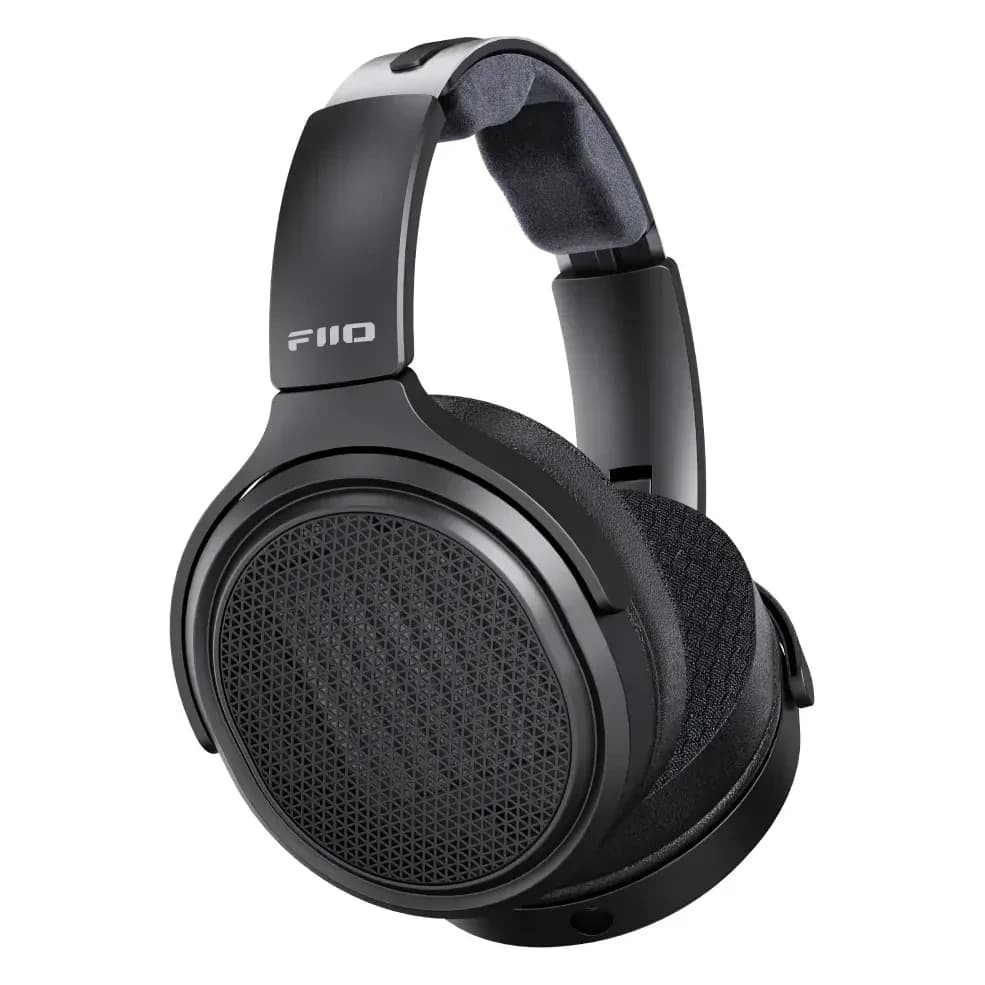
Why impedance alone says little: FiiO's JT3 is 80 Ω and the JT7 only 18 Ω. Yet the JT3 needs less power for the same volume, because it's more sensitive. Our headphone guide puts them side by side.
How to work out what you need
Two formulas tell you how much power and voltage a given volume takes. Pick a target first. We use 100 dB: that's already very loud, fine as a peak in the music, not for hours of listening. The WHO uses 80 dB for 40 hours a week. Our safe listening guide has more on that.
- Power in milliwatts = 10 ^ ((target level − sensitivity in dB/mW) ÷ 10)
- Voltage in volts = √(power in watts × impedance)
An example with the FiiO JT7, the least sensitive headphone we sell: 18 Ω and 92 dB/mW.
- 100 − 92 = 8 dB short of what 1 milliwatt gives.
- 10 ^ (8 ÷ 10) = 6.3 milliwatts.
- √(0.0063 × 18) = 0.34 volts.
- Check with the other spec: FiiO also lists 109 dB/V. 10 ^ ((100 − 109) ÷ 20) = 0.35 volts. The same, give or take rounding.
Every extra 10 dB takes ten times the power and just over three times the voltage. For peaks of 110 dB on the JT7 you'd need 63 milliwatts and 1.1 volts. That's still no problem for the dongles further down this guide.
What our IEMs and headphones need
| Model | Type | Impedance | Sensitivity | mW for 100 dB | Voltage for 100 dB | Max. output impedance (1/8) |
|---|---|---|---|---|---|---|
| KZ EDX Pro | IEM, 1 dynamic | 24 Ω | 112 dB/mW | 0.06 | 39 mV | 3 Ω |
| KZ ZS10 Pro | IEM, 1 dynamic + 4 BA | 30 Ω | 111 dB/mW | 0.08 | 49 mV | 3.8 Ω |
| CCA C10 | IEM, 1 dynamic + 4 BA | 32 Ω | 108 dB/mW | 0.16 | 71 mV | 4 Ω |
| KZ ZST | IEM, 1 dynamic + 1 BA | 16 Ω | 106 dB/mW | 0.25 | 63 mV | 2 Ω |
| FiiO FA19 | IEM, 10 BA | 10 Ω | 106 dB/mW | 0.25 | 50 mV | 1.25 Ω |
| KZ ASF | IEM, 5 BA | 18 Ω | 105 dB/mW | 0.32 | 75 mV | 2.25 Ω |
| FiiO FP3 | IEM, planar | 36 Ω | 105 dB/mW | 0.32 | 107 mV | 4.5 Ω |
| FiiO SnowSky Nature | Headphone, dynamic | 24 Ω | 101 dB/mW | 0.79 | 138 mV | 3 Ω |
| FiiO FT13 | Headphone, dynamic | 32 Ω | 98 dB/mW | 1.6 | 225 mV | 4 Ω |
| FiiO FT5 | Headphone, planar | 36 Ω | 96 dB/mW | 2.5 | 301 mV | 4.5 Ω |
| FiiO FT7 | Headphone, planar | 25 Ω | 94 dB/mW | 4.0 | 316 mV | 3.1 Ω |
| FiiO JT7 | Headphone, planar | 18 Ω | 92 dB/mW | 6.3 | 337 mV | 2.25 Ω |
Power for 100 dB
In-earHeadphone- KZ EDX Pro0.06
- KZ ZS10 Pro0.08
- CCA C100.16
- KZ ZST0.25
- FiiO FA190.25
- KZ ASF0.32
- FiiO FP30.32
- SnowSky Nature0.79
- FiiO FT131.6
- FiiO FT52.5
- FiiO FT74.0
- FiiO JT76.3
milliwatts (log scale). Each step on the axis is ten times the power.
Two things stand out. Every IEM here needs less than half a milliwatt, so volume is almost never the problem with IEMs. And even the planar headphones, known as hard to drive, reach 100 dB on a few milliwatts.
What your phone or dongle delivers
Apple and most other phone makers don't publish the output power of their headphone jack or adapter. Dongle makers do, usually in milliwatts into 32 Ω. A few examples from our range, on the 3.5 mm output:
| Dongle or DAC | Power into 32 Ω (3.5 mm) | Listed by the maker |
|---|---|---|
| iFi GO link 2 Max | 100 mW | 241 mW on 4.4 mm |
| FiiO KA13 | 170 mW | In desktop mode; 550 mW on 4.4 mm |
| FiiO KA17 | 270 mW | In desktop mode; 650 mW on 4.4 mm |
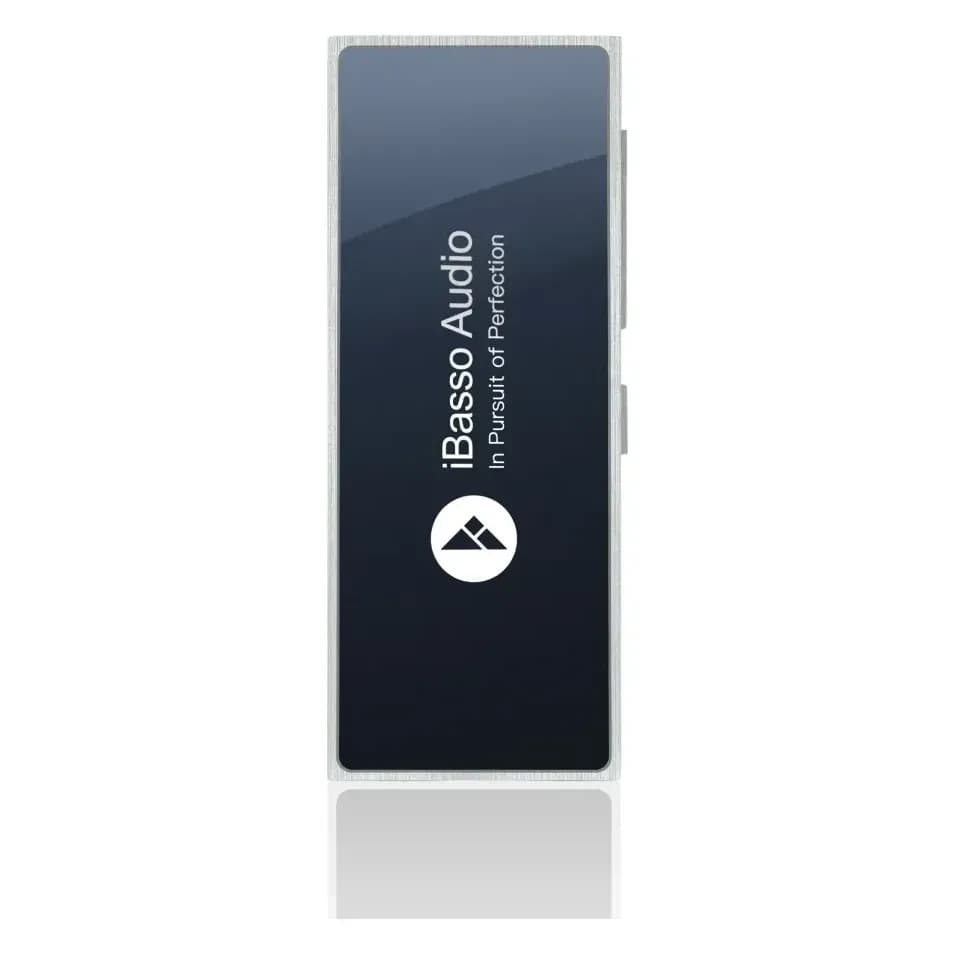
| iBasso DC04 Ultra | 280 mW | 980 mW on 4.4 mm |
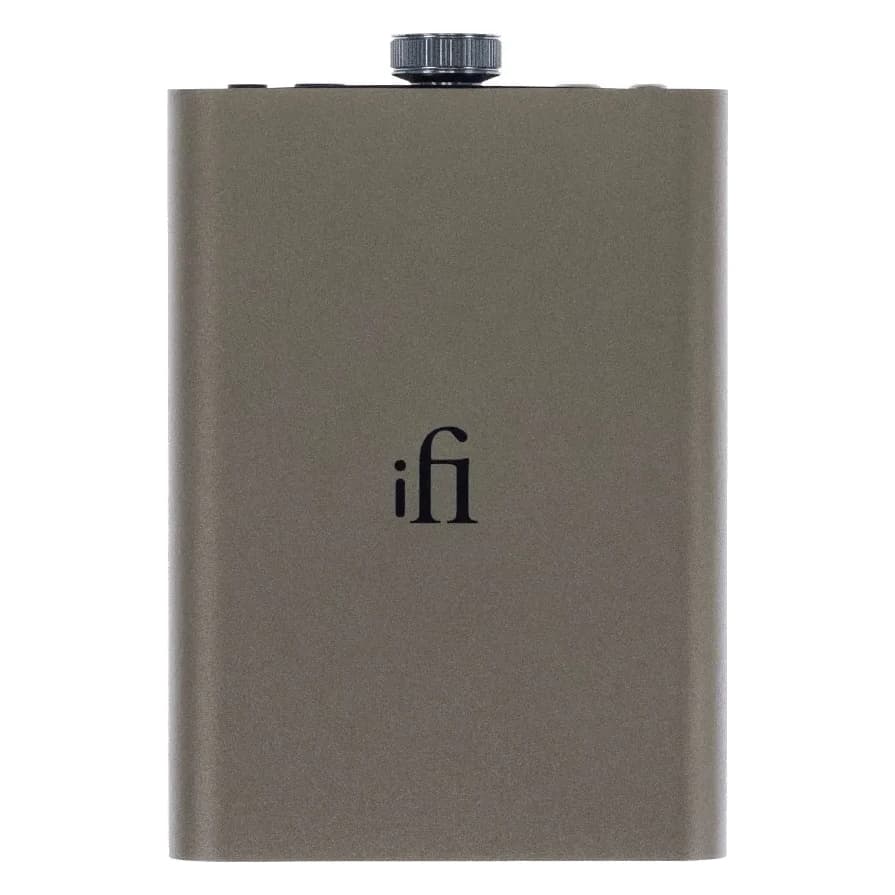
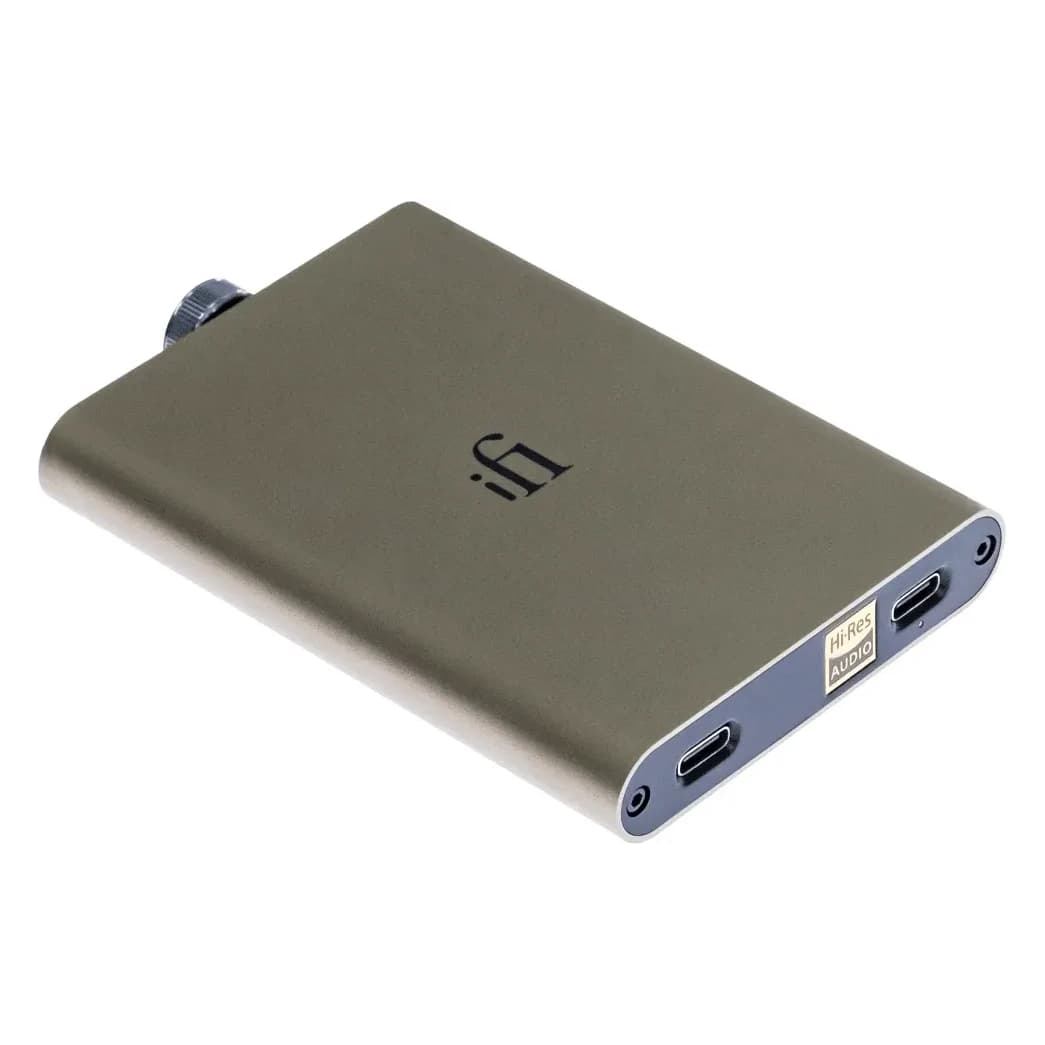
| iFi hip-dac3 | 280 mW | 400 mW on 4.4 mm, with its own battery |
Put that next to the table above and you see how much headroom there is: hundreds of milliwatts against a few tenths for an IEM. Two caveats. The listed power applies at 32 Ω; at a lower impedance a source may deliver less, because more current is needed. And if your phone has a volume limit switched on, the ceiling is lower. Our safe listening guide explains how to set it.
Output impedance and the 1/8 rule
This is where it gets interesting if your IEMs have lots of drivers. Every amplifier has an impedance of its own, the output impedance. It sits in series with your IEM and forms a voltage divider with it: part of the voltage stays behind in the source.
Voltage at the IEM = V × Z(IEM) ÷ (Z(IEM) + Z(out))
Source with 1 Ω output impedance
- Where the IEM is 90 Ω−0.1 dB
- Where the IEM is 10 Ω−0.8 dB
Difference between those frequencies: 0.7 dB
Source with 10 Ω output impedance
- Where the IEM is 90 Ω−0.9 dB
- Where the IEM is 10 Ω−6.0 dB
Difference between those frequencies: 5.1 dB
Example: a multi-driver IEM whose impedance ranges from 10 to 90 Ω across the frequencies.
As long as your IEM's impedance is the same at every frequency, that only costs a little volume. But IEMs with several balanced armatures and a filter (crossover) between them rarely work like that. The well-known audio blogger NwAvGuy used the Ultimate Ears SuperFi 5 as an example: rated at 21 Ω, but anywhere between 10 and 90 Ω depending on frequency. On a 10 Ω source he saw a 6 dB variation in its response, on a 43 Ω source as much as 12 dB.
His rule of thumb: keep the output impedance below an eighth of your headphones' or IEMs' impedance. That's why the last column of the table shows that limit. A single dynamic driver or a planar usually has a flatter impedance and is less affected, but the rule never hurts.
- In our range, the FiiO FA19 (10 BAs) has the lowest listed impedance at 10 Ω. Limit by the rule: 1.25 Ω.
- The KZ ASF has 5 BAs and 18 Ω. Limit: 2.25 Ω.
- According to iFi, the hip-dac3 has an output impedance of at most 1 Ω. Switch iEMatch on and it becomes at most 4.5 Ω. So with the FA19, better leave iEMatch off.
What to look for
Look for 'output impedance' in the specs of your dongle or amplifier. Under 1 Ω covers everything we sell. If it isn't listed, ask the maker or look for an independent measurement.
Hiss with sensitive IEMs
A sensitive IEM makes not just the music loud but also the source's noise. You hear it as a soft hiss in quiet passages. You can work that out too: noise level = sensitivity in dB/V + 20 × log10(noise voltage in volts).
Say a source has 10 microvolts of noise. On the KZ EDX Pro (24 Ω, 112 dB/mW, so 128 dB/V) that becomes 128 − 100 = 28 dB. In a quiet room that can be just audible. On the FiiO JT7 (109 dB/V) it's 9 dB, which you won't hear. So the same source can hiss on your IEMs and be silent on your headphones.
- Look at the noise in microvolts if the maker lists it. A high signal-to-noise ratio (SNR) is measured relative to maximum output. A powerful amplifier with a great SNR can therefore hiss more in absolute terms than a weaker one.
- Use the lowest gain setting that gives you enough volume.
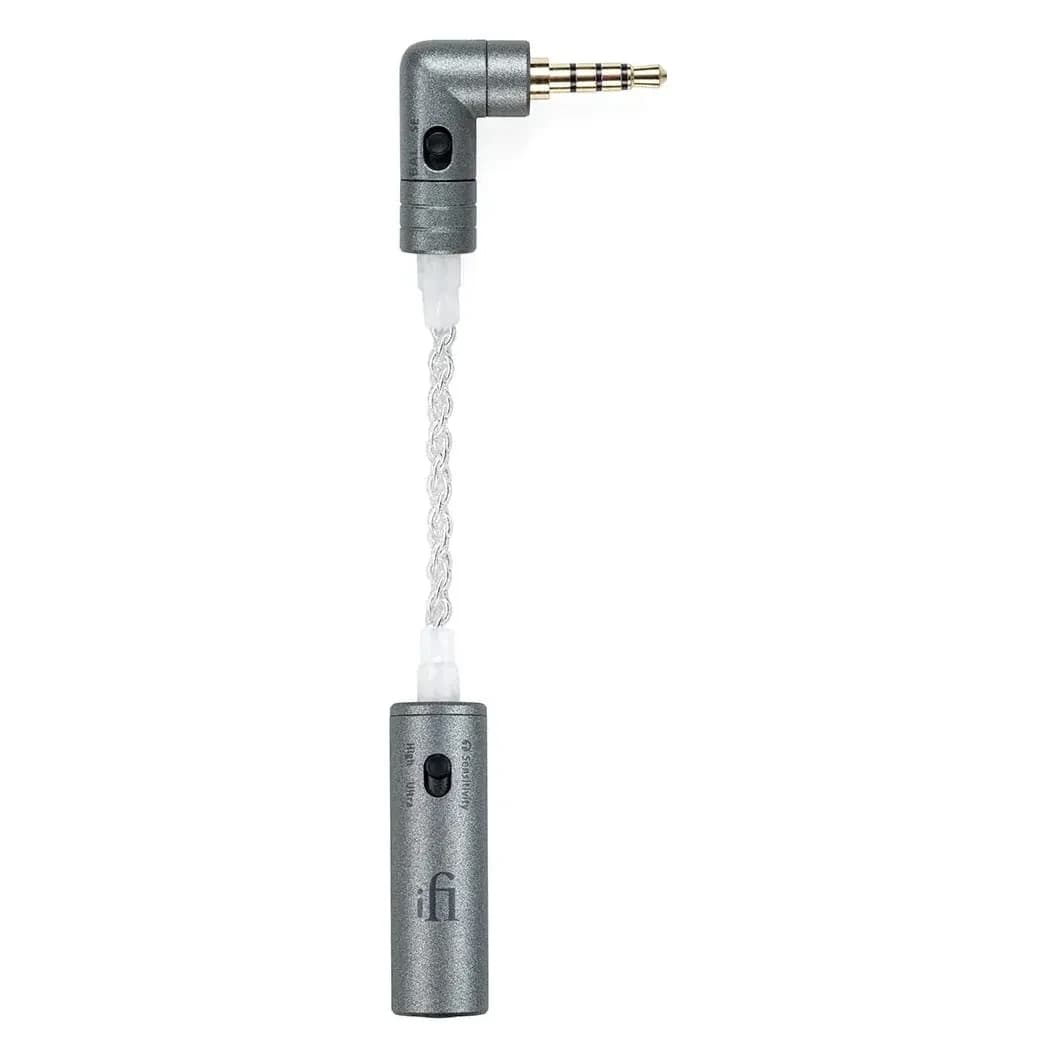
- An attenuator such as the iFi iEMatch+ sits between source and IEMs and lowers the signal, so you can turn the source up. iFi quotes 12.24 dB less noise.
When a dongle really helps
- Your phone has no headphone jack. Then you need a DAC either way, and a good dongle costs little more than a basic adapter.
- You have to turn the volume almost all the way up and it's still too quiet. Check what you need with the table and pick a dongle with plenty of headroom.
- You hear hiss in quiet passages. Then a quieter source or an attenuator helps more than extra power.
- Your IEMs have many BAs and a low impedance. Pick a source with a listed output impedance under 1 Ω.
- You want to use a balanced 4.4 mm cable.
Everything sounds fine at a normal volume, without hiss? Then you don't need anything extra. To find the dongle that suits you, read our USB-C dongle comparison. The basics of DACs and amplifiers are in the guide 'Do you need a DAC or amplifier?'.

Products in this guide
Read next
- 9 min readBalanced (4.4 mm) or 3.5 mm: when does it matter?What a balanced output really does on a dongle, how much extra power it gives on the dongles we sell, when it helps, when it adds hiss, and which adapters are safe.
- 7 min readIEM cables and connectors explained2-pin, MMCX or QDC on the earpiece, 3.5 or 4.4 mm at the other end. What fits what, when a new cable is worth it, and when it isn't.
- 7 min readMaking wired IEMs wireless: Bluetooth cable or receiverHow a Bluetooth upgrade cable works, what SBC, AAC, aptX and LDAC mean, how much delay to expect, why you check the connector first and what to use when the cable doesn't fit.