By Rejhan Kavazbasic · 7 min read · Updated 30 October 2026
Safe listening: how loud, how long
The WHO and EU guideline in plain numbers, why every 3 dB counts, how a good seal lets you turn down, and the warning signs that mean you should see a doctor.
Hearing damage is a matter of dose
Noise damages the hair cells in your inner ear, and those don't grow back. What counts is the dose: how loud, multiplied by how long. A short burst at a high level can do as much harm as hours at a moderate level.
The guideline most of Europe works with comes from the WHO and the ITU. Their Global Standard for Safe Listening Devices and Systems (ITU-T H.870, 2019) sets the reference for adults at 80 dB(A) for 40 hours a week. For children and people with sensitive hearing it's 75 dB(A) for the same 40 hours.
- 80 dB40 hWHO reference
- 83 dB20 h
- 86 dB10 h
- 89 dB5 h
- 92 dB2 h 30 min
- 95 dB1 h 15 min
- 98 dB38 min
- 101 dB19 min
Every 3 dB louder halves the time.
The 3 dB rule
Decibels are logarithmic. Plus 3 dB means twice the sound energy, so your safe time halves. 83 dB gives you 20 hours a week, 89 dB gives you 5, and at 95 dB you're at 1 hour 15 minutes for the whole week.
That's the uncomfortable part. Turning up a few notches doesn't feel like much, but it takes a big bite out of your weekly allowance.
| Source | What it says |
|---|---|
| WHO and ITU, Global Standard for Safe Listening Devices and Systems (H.870) | 80 dB(A) for 40 hours a week for adults, 75 dB(A) for children. Devices should track your dose and warn you. |
| European Commission, SCENIHR opinion on personal music players (2008) | 80 dB(A) for 40 hours a week is safe. Listening at 89 dB(A) for more than 5 hours a week, over five years, puts your hearing at risk of permanent damage. |
| European safety standards for music players (EN 50332 and related) | Phones and players sold in the EU warn you when you go above a safe default level. That's the pop-up you see when you turn up. |
| WHO Global Standard for Safe Listening Venues and Events (2022) | Concerts and clubs: no more than 100 dB(A) averaged over 15 minutes. |
Your volume slider isn't a dB meter
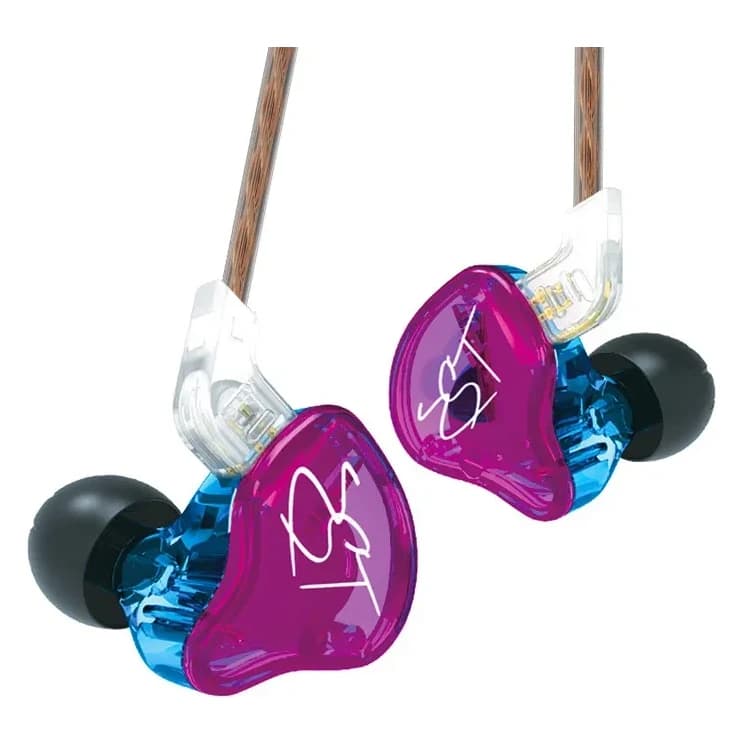
Half volume on your phone means something different for every IEM. It depends on sensitivity and impedance. Take two IEMs from our range: the KZ EDX Pro (112 dB/mW, 24 Ω) and the KZ ZST (106 dB/mW, 16 Ω). From the same phone at the same volume step, the EDX Pro plays about 4 dB louder according to those specs. Per the 3 dB rule that's less than half the safe listening time.
So when you switch IEMs, don't trust the volume step you're used to. Start low and turn up until it sounds right, not until the slider is where it always was.



Isolation lets you turn it down
Most people don't listen loud because they like it loud. They turn up to drown out a train, a bus or a busy street. An IEM that seals well blocks a lot of that noise before it reaches your ear, so you don't have to compete with it.
That's why fit is a hearing protection issue too. If the tip leaks, you lose bass and outside noise comes in, and the reflex is to turn up. Try the other tip sizes first, per ear. Foam tips isolate best, as the ear tips guide explains.
A simple habit
Set your volume at home in a quiet room. Then, on the train, leave it there. If the music disappears under the noise, check the fit before you touch the volume.

Volume limits on your phone
Your phone can do the counting for you.
- iPhone: under Settings, Sounds & Haptics, Headphone Safety you can turn on Reduce Loud Audio and choose a maximum level in dB (menu names can differ a little between iOS versions). The Health app shows your headphone audio levels per week. Apple notes that with headphones that aren't Apple or Beats, the levels are an estimate.
- Samsung: the volume settings have a media volume limiter. Other Android phones often have a similar setting under Sound, but the name and location differ per brand.
- Phones sold in the EU show a warning when you go above the safe default level. It's tempting to tap it away. It's there for a reason.
A limit you set once works better than a resolution you have to keep every day.
Warning signs and when to see a doctor
Your ears tell you when they've had too much. Take these seriously:
- Ringing, buzzing or hissing in your ears after listening or after a concert (tinnitus).
- Muffled hearing afterwards, as if there's cotton wool in your ears.
- Struggling to follow a conversation in a noisy café, where that used to be easy.
- Everyday sounds suddenly feeling uncomfortably loud.
If ringing or muffled hearing goes away within a day, that was a temporary threshold shift. Your ears recovered, but it's a sign the dose was too high. Give them rest and listen quieter.
See your GP if tinnitus or reduced hearing doesn't go away within a few days. Your GP can refer you to an ENT specialist or an audiology centre for a proper hearing test. If you suddenly lose hearing in one ear, contact your GP the same day. Sudden hearing loss is treated more successfully the sooner it's seen.
Good to know
This guide is general information, not medical advice. If you're worried about your hearing, see your GP or an audiologist.
A routine that works
- Get the fit right first: the right tip size for each ear.
- Set a volume limit on your phone.
- Set your volume in a quiet room, and start low when you switch IEMs.
- Take breaks. A few minutes without sound every hour gives your ears time to recover.
- Wear earplugs at concerts and in clubs. Your IEMs are for your own music, not for blocking a PA.
You don't have to listen less. Most of the gain comes from a good fit and a limit you set once.